Geomantica 97
October 2026
The magazine of Earth harmony, via dowsing, geomancy, esoteric gardening & agriculture,
and eco-sensitive living, since 1998. Edited by Alanna Moore.
Geo 97 Contents
Editorial. Letter.
News – Alanna Moore’s new book out now – Divining the Otherworlds
News in other media –
Australian Aboriginal culture stories:
What is the story of the ‘Welcome to Country’ ceremony in Australia? Meet the women rangers working to protect country; Aboriginal clever people practice.
Positive environmental stories:
‘Contract between humans and river’: River Avon’s rights enshrined in charter; ‘Fresh from the roof’: growing salad a few metres above the supermarket tills; In Chile, injured penguins sport copper vests to help them heal; Pulverised recycled glass helps boost farm productivity; Australia’s ‘woody meadows’ raise biodiversity in cities; Fairy rings and dead zones: The strange science of mushroom patterns; Can regenerative agriculture save our food?; Bees contain tiny magnetic particles, suggesting navigational ability; ‘It makes your heart sing’: a pioneering project of re-wilding; Dolphins guide stranded whale out of estuary; Swiss startup recycling urine to make fertiliser; Bees use tools to solve problems; Record number of dams dismantled in Europe help wildlife to thrive; Respect for big trees in Taiwan; New generation embraces permaculture.
Ancient Mysteries:
Greek computer that predicted eclipses 2,000 years ago; Bolts of Lightning Are Flashing Deep in the Ocean; Ancient Spiraling Holes in Peru; Sasquatch ‘sightings’ in Canada.
Mind:
Slime moulds and the nature of intelligence; Plant consciousness; She sat under an oak tree every day for a year; People who can ‘absorb’ a richer version of reality.
EMFs:
‘Electrical vampire’ technology; Unravelling the mystery of ‘Havana syndrome’.
Feature Articles
* Musings on the spiritual values of sacred sites
by Alanna Moore October 2026
* WB Yeats and the fairy lore of Ireland
by Alanna Moore September 2026
* Obituary – Vale Billy Gawn, Irish dowser extraordinaire.
What’s happenning? Alanna Moore’s upcoming workshops in Malaysia and Australia
————————————————————————————————
G97 Editorial
Dear Folks,
Welcome to the October 2026 edition of Geomantica magazine.
With an article about a visit to an Irish Holy Well, plus another on the magical childhood world of W B Yeats, it continues with an Irish flavour. However, as autumn leaves change colour and fall, I pack my bags to leave Ireland after a good many years here, to return to live in Australia. I shall miss Europe and my friends and family there.
But I’ll take back with me a great appreciation of ancient Celtic culture, knowledge of the Irish Dreamtime of my ancestry, Celtic Shamanism and the greater European heritage it all stems from. It has been a wonderful adventure for me in Europe, but that time is coming to an end.
Find out about my latest book – Divining the Otherworlds – that features the Irish Otherworlds, as well as those of other lands, traditions and cultural landscapes. This compilation of descriptions of other-dimensional spirit worlds aims to de-mystify the subject and provide practical and helpful insights. Find out more in this issue.
Would be great to get readers’ contributions for possible publication in future Geomanticas. You are most welcome to send letters and articles.
If you wish to be informed of new magazines, books and events with occasional emails, write to info@geomantica.com to be included on one of Geomantica’s regional email lists.
You can also catch up on Geomantica news at http://www.facebook.com/alannamooresgeomantica
Until the next edition, in February 2027 (then out in May and the 100th edition in August 2027) – Happy Samhain/Halloween, Celtic New Year 1st November and Summer / Winter Solstice, Yuletide, etc etc!
Happy reading,
Your editor,
Alanna Moore
Geo 97 Letter
“Just a quick email from me to express my deep gratitude for all your work in sharing your knowledge of dowsing, permaculture, devas and ancient sites. I have several of your books now and I have learnt so much, my awareness of the energies around me has opened up no end….Many thanks for your work, blessed be your move to Australia.”
DB, May 2026
Geo 97 News
New book out now: Divining the Otherworlds
ISBN – 978-0-6452854-6-8
Alanna Moore
Python Press
Published: September 2026.
Available globally online, in Australian bookstores, and from Geomantica HERE.
Ancient traditions of a supernatural spirit world are similar globally, especially in their most archaic forms. They talk of the Other, the Dreaming, etc. It’s an other-dimensional, parallel universe that’s all around us, but usually invisible. Each culture would have it’s own Otherworld and folklore warns us to navigate these Fairylands with care and respect.
But how to know it? In our innate sensory potential, we can perceive it directly, if we find a means to lift the veil between the worlds. The ancient art of divining is one such means. You don’t need any particular belief system to sense or work with the Other, ideally just an open and inquisitive mind, the capacity for intense focus, calm and fearlessness, and a kind heart.
When the world of spirit collides uncomfortably with ours and we need to find ways to investigate – this book provides just the thing. Alanna Moore has over forty years experience of dealing with Other dimensional problems impacting people’s homes and the places they frequent. She’s well qualified to present this overview of everyday spirit manifestations, ways to deal with unwanted ones, means of their perception and how to restore harmony to haunted homes.
Reviews:
“A fascinating exploration of spirit ecologies across cultures.”
Melanie Lorien, International House Healing Network, Ireland August 2026.
“This is the twelfth book Alanna Moore has written. She has travelled the world doing geomancy land healing and teaching… Every chapter is a startling new perspective on the Otherworlds. Shamanic strangeness permeates the book revealing the true goodness in nature. Australia, Malaysia, Ireland, England, Germany and many other countries are cited where unseen life influences the physical world and people with good hearts can communicate with the spirits who know the natural ways to heal the planet.
“Alanna Moore includes decades of exploration of mysterious events. She researched what she calls the ‘otherworlds’ …. used dowsing pendulums to open the doorway and then developed a meditation technique to actually see into the finer ghostly realms. She attributes her second sight to her Irish roots. Religious and scientific beliefs had blocked access to these subjects. Australian Aboriginal lore showed an approach to dreamtime. Theosophical literature showed that others had explored the same subject matter previously and benefited. Meditating on alien phenomena extended her study. Psychics and dowsers shared their explorations.
“Ancestral spirits of the dead played a part in her awakening. Conversations with Aboriginal people revealed a treasure trove of insights. Poltergeists showed that old belief systems need revision. Clearing houses of ghosts also played a part. Removing spirit attachments demonstrated that old shamanic methods worked.
“Nature spirits, fairies, devas and other elementals extended the scope of her explorations. They aided her. She felt especially close to water elementals. The very land was spirit. Geomancy is best guided by the devas who care for the land and know what must be done to clear the damage to it. Alanna has done this work. Crop circles are created by devas and gnomes as a healing blessing. Guiding the clearing of psychic and physical pollution from the land is best done from the higher realms.“Understanding ley lines and knowing how to work with them or around them is best achieved from an otherworldly perspective. Leys are part of the earth’s living structure. Many living spirits occupy the same spaces, like nesting dolls of symbiotic life.
“Archives of the Akasha are in the higher finer realms. Acceptance of otherworld communication opens huge libraries for advancing the development of the soul.”
Zuerrnnovahh-Starr Livingstone, Canadian Questers Society, September 2026.
“Divining the Otherworlds is an excellent introduction to many of the spirit realms and how to navigate them, conduct yourself safely and make the world a better place…. Alanna’s journey with the spirit worlds started at age fourteen when she moved into a bedroom situated over a geo-vortex which was a portal for their appearance.
“Alanna is widely read in the spiritual sciences and cites many authors such as Geoffrey Hodson, C.W. Leadbeater, Marco Pogacnik and others. Alanna herself is a pro dowser, having worked for hundreds of clients – clearing houses, helping Earthbound dead move to higher realms, helping resolve difficulties with energy lines and vortexes. She gives many stories from her own experiences with the spirit realms. She also includes experiences of friends who are seers and clairvoyants. Alanna is not a sensationalist. This is matter of fact information.
“Alanna has made a handy Spirit Dowsing Checklist for 30 types of spirits to help you determine what type of spirit you are encountering. She points out that we can all learn to dowse with a pendulum with practice. With her list, all you do is point to each being on the checklist and dowse for yes or no answers. I would add dragon and sasquatch to the list for my own uses and the reader may add others as well. Most of Alanna’s experience is from Ireland and Australia (including Australian Aboriginal viewpoints) but would be relevant to seekers everywhere.
“After having read hundreds of books on the spiritual realms I can honestly recommend Alanna’s book for its clarity and ease of understanding. Divining the Otherworlds is similar in genre to William Bloom’s book Psychic Protection: Creating Positive Energies for People and Places; Anastacia J. Nutt’s book Unseen Worlds and Practical Aspects of Spiritual Discernment; and David Spangler’s Subtle Worlds: An Explorer’s Field Notes. Alanna’s book is a splendid addition to the field.”
Michael Pilarski, founder of the Fairy & Human Relations Congress, USA, September 2026.
“…[B]rowsing through, it pricked my attention. First it is very well written with a lot of images, so I started to read it there and then, well, I could not put it down. There are so many personal stories to illustrate each
chapter, I love that, I felt I could relate and live the adventures with Alanna, I am even in one of them when we dowsed together at the Coogee headland and saw the Golden Deva (Alanna did see her, I only felt her).
Remember Dr Karim saying “If you can see the invisible, you can do the impossible” So with Alanna, the book lets me see through her eyes at the hidden part of this world we live in.
“The book covers all aspects of the invisible energies, entities, beings etc. who live around us, but that we cannot see, and how to deal with them. Alanna shares so many personal experiences covering just about every aspect of that Otherworld, we cannot see, but she does. I love the flowing rhythm of her prose, I could not put the book down. This is really a ‘keeper’. You will have to read it”.
Francois Capmeil, NSW Dowsers Society newsletter, October 2026.
News in other media
Australian Aboriginal culture stories
What is the story of the ‘Welcome to Country’ ceremony in Australia?
Meet the women rangers working to protect country
Among the desert landscapes and the magnificent rock formations iconic to Central Australia are the Aboriginal rangers who care for the land. It is a vocation that has historically been male-dominated, but a recent women’s ranger camp has helped encourage more women to get involved in the protection of sacred sites and stories.
Sacred rock art
In Western Arnhem Land in the Northern Territory the Markani estate of the Madjawarr clan is full of stories. Short video of a an elder visiting and talking about a sacred rock art shelter.
https://www.abc.net.au/news/2026-07-08/this-place-djimubarn-sacred-rock-art-shelter/106870222
Aboriginal clever people practice
Positive environmental stories:
‘Contract between humans and river’: River Avon’s rights enshrined in charter
River charters part of wider movement establishing ‘moral’ framework to protect nature and hold institutions to account.
One Monday morning in spring last year, 12 people gathered in the morning drizzle at Joyce’s Pool, one of the sources of the Bristol River Avon, and took the first steps of the inaugural Avon pilgrimage.Over the course of eight days, a revolving cast of pilgrims walked about 100 miles from the source of the river to the point at which it reaches the sea, in some cases bivvying on the riverside at night. Along the way they planted trees, sowed seeds, restored footpaths and presented councillors and decision-makers with a fledgling Avon charter, developed by the Bristol campaign group Conham Bathing.
“The reception was so good across political parties and interest groups,” recalls pilgrim Hamish Evans, who co-founded We Are Avon, which organised the pilgrimage and is building a movement to regenerate the Avon bioregion. “It felt inevitable that we would one day achieve better rights and representation for this river.”
On Sunday, World Rivers Day marked a breakthrough for the annual pilgrimage and wider Avon campaigning. Councillors, environmental groups, river guardians, and members of the public gathered at 11am at Parade Gardens in Bath to publicly sign the Avon bioregional charter of river rights (ABCRR).
The charter enshrines the Avon’s rights to exist, thrive, and evolve naturally, to flow sustainably, to not be polluted, to preserve its biodiversity, to aim for regeneration and restoration, to build cultural and community connection, and to represent and advocate for the rights of the river.
River charters are part of a national and international movement to establish legal rights and stronger agency for nature. Recent UK initiatives include Lewes town council recognising the rights of trees, organisations putting nature on the board, “interspecies councils” exploring interspecies decision-making, and a nature’s rights bill being debated in parliament.
About 40 river charters have emerged since the Sussex River Ouse became the first in England to have its rights recognised by a local authority, in February 2025. The ABCRR contains similar language, but it also breaks new ground. An unprecedented nine councils have endorsed it, including Bath and North East Somerset (B&NES), Bristol City, and North Somerset (under its motion for the ocean). More are expected to follow. We Are Avon’s bioregional movement also represents a new model for upholding charter rights.
https://www.theguardian.com/environment/2026/sep/28/river-avon-charter-bristol
‘Fresh from the roof’: the supermarket growing salad a few metres above the tills
https://www.theguardian.com/environment/2026/sep/11/supermarket-salad-rooftop-garden-berlin
In Chile, injured penguins sport copper vests to help them heal
Pulverised recycled glass helps boost farm productivity with benefits to soil, plants and livestock
A growing number of Australian farmers are spraying or spreading pulverised glass on their paddocks to boost the productivity of their soils, plants and livestock. Victorian agronomist Peter Norwood has been recommending the Queensland-made organic product to clients for several years.
“There could be as much as 25 or 30 per cent improvements in plant growth and plant productivity,” Mr Norwood said.
https://www.abc.net.au/news/2026-07-31/ground-glass-silicon-fertiliser-farm-productivity/106963488
Australia’s ‘woody meadows’ raise biodiversity in cities
A woody meadow is a planting method using tightly-packed native plants that mimics colourful Australian shrublands.
Self-sustaining wonderlands of native plants that are coppiced every few years and thicken up to choke out weeds and keep in moisture.
https://www.abc.net.au/news/science/2026-08-07/woody-meadows-native-plants-council/106034578
Fairy rings and dead zones: the strange science of mushroom patterns
With fungi, there’s a lot going on beneath the surface.
https://www.sciencefocus.com/nature/fairy-rings-and-dead-zones
Nutrients in our food are declining. Can regenerative agriculture save it?
For the last few decades, the nutrient content of our crops has been declining. In the late 90s, the US Department of Agriculture found the vitamin C content of lemons had decreased by almost a third over the previous 22 years. Calcium in carrots, an important source especially for non-meat eaters, had reduced, on average, by more than a quarter. Vitamin A in bananas was down by 57%. The mineral content of wheat has declined by between 20-30% since the 1960s.
A number of reasons have been suggested for this worrying decline…..One group of agricultural researchers, however, argues that the answer to declining nutrients may be … regenerative agriculture. This “focuses on building organic matter and ecosystems in the soil”…
Dr David Montgomery, a US geologist and the co-author of the book What Your Food Ate, says we need regenerative agriculture to right the wrongs of the “degenerative” farming that helped sustain a postwar population boom but wrecked soil health in the process.
“It was the microbial truckers and miners in our soils that got put off the job by conventional agriculture,” he says. “Regenerative practices that treat soil as an ecosystem can return those miners and truckers to the job.” Montgomery and his wife, Anne Biklé, a biologist, undertook a study in 2022, albeit on a much smaller scale, noting some correlation between regenerative agriculture and higher nutrient density in food crops in the US.
Other studies support these findings. A large literature review by Newcastle University in 2015, for example, found that a switch to eating organic fruit, vegetable and cereals – and food made from them – would provide additional antioxidants equivalent to eating between one to two extra portions of fruit and vegetables a day. The Bionutrient Institute multi-year study framework tested thousands of samples and found that the strongest positive correlation for high nutritional value was the biological activity and overall health of the soil.
Bees of many species contain tiny magnetic particles – suggesting an innate magnetic compass for navigation
A surprisingly large number and diversity of bee species – 74 out of 96 tested – have magnetic properties, according to research my colleagues and I recently published in the journal Science Advances. Some animals are able to use iron-based magnetic compounds such as magnetite to detect and navigate via the Earth’s magnetic field – a sense called magnetoreception. We considered magnetism in the insects we tested to be a proxy for which species might be magnetoreceptive.
‘It makes your heart sing’: can a pioneering project show that rewilding really works?
Intensive farming has all but destroyed England’s ancient woodlands and freshwater wetlands. On a farm in Lincolnshire a radical aristocrat hopes to show there’s money in protecting nature.
https://www.theguardian.com/news/2026/jul/09/it-makes-your-heart-sing-rewilding-britains-bleak-farmland
Dolphins guide stranded whale out of WA estuary
https://www.abc.net.au/news/2026-07-17/whale-saved-by-dolphins-in-estuary/106927030
Swiss startup recycling urine to make natural fertiliser
As recent conflicts expose vulnerability of fertiliser markets and its effect on food security, VunaNexus offers an alternative. Special toilets that look like normal facilities send the separated liquid, without diluting it with water, down a piping system into a small treatment plant in the basement of the building. There, the urine goes through a series of tanks that remove micropollutants, such as antibiotics, and concentrate valuable nutrients such as nitrogen and phosphorus that are essential for plant growth. The liquid is then pasteurised at 90C, killing any potential viruses and other pathogens. The distilled water is separated and reinjected into the flushing system before a liquid fertiliser called Aurin comes out on the other side.
https://www.theguardian.com/environment/2026/jun/04/startup-recycling-urine-natural-fertiliser-vunanexus
‘They surprise me every time’: bees can use tools to solve problems, study finds
Insects join list of species capable of solving simple ‘box-and-banana’ problem that demonstrates basic intelligence
https://www.theguardian.com/environment/2026/jun/04/bees-use-tools-to-solve-problems-study-finds
Record number of dams dismantled in Europe to help wildlife thrive
Weirs, culverts and sluices among 602 barriers demolished in year in attempt to restore 15,500 miles of rivers by 2030. A few miles downstream from a lava field in western Iceland, the gargle of free-flowing water is unbroken for the first time in decades after hydraulic peckers chipped away at a dilapidated dam that once powered a farm. The structure on the River Melsá had continued to block fish migration long after falling into disrepair. “It wasn’t providing any electricity; the old power house had sheep living in it,” said Hamish Moir, a river engineer from CBEC, a Scottish firm that provided technical support for the demolition in December. To see the river restored to its natural state was “really rewarding”, he said.
The dam was officially the first that Iceland has removed from its rivers, but across Europe a record-breaking 602 barriers were removed last year, according to new analysis. A report from Dam Removal Europe found that the number of dams, weirs, culverts and sluices dismantled grew by 11% from the year before, letting more waterways resume their natural course. It is part of a global trend to restore rivers to help wildlife thrive.
Respect for big trees in Taiwan
The Heaven Sword is the tallest tree in East Asia. Found on the island of Taiwan,
it measured a whopping 84.1 metres tall, the 1,000-year-old tree is an ancient cypress species.
Despite its seemingly unmissable height, it was only found a few years ago through a decade-long project to map Taiwan’s tallest trees. The tall tree, and the methods used to find it, are described in a new study published in Frontiers.
Large trees create their own mini-ecosystems, according to lead author Rebecca Hsu, a forest ecologist at the Taiwan Forestry Research Institute. Before climbing any tree, the Taiwanese team members would pay their respects and hug the tree.
“We Taiwanese believe old trees have their own spirits, so we would like to have permission to climb them,” Dr Hsu said.
New generation embraces permaculture, which took root in 1970s oil crisis
When Kirsty and Bart Whitehouse moved to Margaret River eight years ago, they set about turning a cow paddock into a permaculture paradise. “We hardly had any birds here, we hardly had any lizards, there was just no flora or fauna to support that,” Ms Whitehouse said. “One of the most satisfying things is to see all the birds come back.” The couple is part of a new generation embracing the principles of sustainability espoused by the permaculture movement.
Permaculturists say there is renewed interest in the counter-culture, amid rising costs and concerns for food security.
Ancient Mysteries
Antikythera mechanism: Greek computer that predicted eclipses 2,000 years ago. A shipwreck off the Greek island Antikythera revealed in 1901 a bronze mechanism over 2,000 years old that tracked lunar and solar cycles and eclipses, now seen as the first analogue computer.
Mysterious Bolts of Lightning Are Flashing Deep in the Ocean. Scientists Still Can’t Explain Why.
It guided Polynesian wayfinders for thousands of years, but the cause remains unknown. Te lapa is a phenomenon in which light flashes underwater like a linear bolt of lightning, but there’s been much debate and confusion over what causes it. Some theories suggest that, despite saltwater being an excellent conductor, certain conditions in the depths make it possible for electricity to build up until it’s discharged. Another theory, though a less likely one, is that te lapa could be produced by bioluminescent microbes known as dinoflagellates, which glow in response to pressure waves.
Scientists Think They’ve Found the Reason for Ancient Spiraling Holes in Peru
The Nasca region of Peru has puzzled scientists for as long as they’ve studied the site. Along with the famous geometric Nasca lines, the desert environment features funnel-like stone lined spiraling holes known as puquios. For centuries, nobody knew what the puquios were for. Or who made them. Or when.
First discovered in the early 1600s, these spiraling holes pepper the dry region of Peru, which suffers intense drought for months, if not years, at a time. How pre-Hispanic populations lived there baffled researchers, but after some bird’s-eye research using satellite imagery, the puquios may provide a proper explanation.
Sasquatch ‘sightings’ in Canada
Latest reports from rural Ontario add to tales going back decades about bipedal creature also known as Bigfoot
On a recent evening, residents in a corner of rural Ontario reported a series of strange encounters.
“The birds stopped, the wind seemed to die down, and it got oddly quiet. That’s when I noticed movement ahead of me,” one witness wrote. A “strong, earthy smell” hung in the air. Then, “a massive figure slowly stepped out from behind the trees, and my heart instantly started racing”. Moments later, it vanished back into the forest and “everything slowly went back to normal”. The following morning, another witness reported seeing two creatures around sunrise. “One big, one not so big. The cinnamon was prominent on the smaller one,” they wrote. “There was an earthy stench.” The pair appeared to be scavenging through garbage. When the witness knocked on wood to scare them off, “they knocked back. That scared me off.”
The creatures’ size, smell and movement matched closely with descriptions of the Sasquatch, or Bigfoot, a bipedal ape that believers say exists at the periphery of human understanding. Centuries before European settlers arrived, Indigenous nations told stories about large human-like creatures living in forests that transitioned between physical and spiritual worlds. Others believed it was a malevolent force that served as cautionary tale for children.
But it was not until 1929 that a magazine article first thrust the idea of a primeval survivor in the woods into the broader public consciousness. The piece, written by an Indian agent, recounted stories from the Chehalis First Nation, which told of the “Sasquatch” – taking the name “Sasq’ets” from the Halq’eméylem language.
In the following years, thousands of reports flooded in, the majority of which described a large, dark-haired bipedal ape that was skittish around humans. Even the renowned primatologist Jane Goodall conceded she was a “romantic” when it came to the prospect of something yet undiscovered. “I don’t want to disbelieve,” she said. The naturalist David Attenborough takes a more measured approach, suggesting Sasquatch – and its Himalayan counterpart the Yeti – reflect a long-held cultural memory of a long-extinct primate.
Sceptics argue that Sasquatch believers underestimate just how many of these mammals would have to exist in order to maintain a breeding population that could persist for generations. For a giant primate to survive, there would need to be a population of several hundred individuals, across a large and wild environment. So far, no bones, body or DNA samples have ever been recovered. Footprints have proven frustratingly divisive.
https://www.theguardian.com/world/2026/jun/11/sasquatch-bigfoot-sightings-fervour-scepticism-ape-ontario
Mind:
Slime moulds and the debate over the nature of intelligence
Scientists are battling over whether supposedly simple organisms should be considered ‘intelligent’. The outcome could reshape our understanding of the natural world – and our own place within it.
https://www.theguardian.com/news/ng-interactive/2026/sep/08/this-is-dangerous-slime-moulds-and-the-bitter-debate-over-the-nature-of-intelligence
Plant consciousness studies
https://www.popularmechanics.com/science/environment/a71562782/plant-consciousness-humans/?utm_source=firefox-newtab-en-ie
She sat under an oak tree every day for a year
After a period of burnout, the author realised that nature knows what you need, and is always ready to offer it – you just have to be quiet enough to receive it
Some People Can ‘Absorb’ a Richer Version of Reality, Scientists Say. Are You One of Them?
You can learn it—and “make life enchanted through the power of your mind.”
The sun slips below the horizon, washing the sky in color. A powerful strain of music swells and fills a concert hall. For many people these are delightful experiences. For others, they’re emotional, transformative moments that they feel throughout their bodies. What’s the difference between these two observers? According to some researchers, it’s a collection of attributes with the prosaic name “trait absorption.”
People who are high in absorption live in a rich inner world of imagination, but they also “absorb” external experiences. They often experiment with consciousness-altering substances and seek intense encounters with nature, travel, art, and spirituality. The reason why high absorbers experience things in such a different way is still a mystery. It might be genetic, related to trauma—or it could be something that you can learn.
EMFs:
‘Electrical vampire’ technology
According to the International Energy Agency, a single ChatGPT request requires 10 times more electricity than a Google search.
Unravelling the mystery of ‘Havana syndrome’
Dozens of CIA officers have been afflicted by debilitating symptoms over the past decade. Are they the result of ‘mass hysteria’? Or are they from attacks with an energy weapon and, if so, who is responsible? And has there been a cover-up?
A just published book covers this story – The Havana Syndrome by Michael Rey and Oriana Zill de Granados
In this article they speak of sometimes finding Russian mobile phones in the vicinity of the people, typically CIA agents, who had been energetically attacked (‘allegedly’). They mention pulsed microwaves being the possible cause of the symptoms, the majority of which being awful migraines, dizziness and vomiting.
Editor’s comments –
This sounds like how the editor, an electro-sensitive person, feels after exposure to pulsed microwave and RF waves from ordinary mobile phones (and other wireless devices)! We should not be surprised by this phenomena, as mobiles were developed by the military, after all. (I don’t have one.) The Guardian article also says that the possible weapon that was used can be bought on the ‘dark web’. I have spoken to two individuals in Victoria who believe that they were attacked by such weapons. They were campaigning against 5G at the time. One was ill for 6 months before he fully recovered.
Perhaps the moral of the story might be: don’t have a mobile phone. It could be possibly used to not just track your whereabouts and steal your data, but also attack you and leave permanent neurological damage!
https://www.theguardian.com/us-news/ng-interactive/2026/oct/10/havana-syndrome-mystery-cia-russia
Feature Articles
Musings on the spiritual values of sacred sites
Alanna Moore October 2026
In the summer of 2019 a group of Malaysian Chinese friends of mine came to tour sacred places in north west Ireland with me. I had a list of possible destinations, but with so much to see we needed to prioritise and choose carefully. People have different expectations, that are often based on cultural bias. No one tour to the same place will be the same. I have some common assumptions about people’s wishes, but need to remind myself that assumptions can be very wrong.
A German visitor friend, esoteric book publisher Georg Dehn from Leipzig, had simply stated to me on his visit – “I just want to see megaliths!” Megalithic monuments are the poster child of the deep past. They are usually associated with death – as tombs and death ritual settings, for ancestor worship and ancestor spirits, and as territorial markers. My Malaysian friends were not at all keen to visit Neolithic tombs and kept their distance when we did so, though impressive bits of architecture from a mind boggling circa 5000 years ago.
Discussing some places in the region that we might visit another day, I mentioned some interesting church and monastery sites. Siew Foong had a sightly worried look as she asked me a legitimate question, one that might rarely or never be raised in polite geomantic circles. It gave me a good reality check.
“But Alanna, how do you know that these places are sacred? Are they sacred because people just say they are? In Malaysia there are Taoist temples where people go to pray for money. Is that also sacred, then?”
Memory takes me back to temple shops in Malaysia, where I saw that you can buy paper money notes to take to the Taoist temple and burn; or use it to help send off a loved one at their funeral. So Siew Foong’s point was worth considering. One culture’s idea of the sacred can be very different to another’s. And from my studies of Irish heritage, I also know that ancient folklore was often twisted for propaganda purposes, for example – re-imagining the ancestry of warmongering tribes who wished to fake their lineage and tie it to lands of conquest.
How holy is that?
It seems like a good idea to consider reviewing ‘sacred’ and ‘holy’ sites and perhaps to rate them somehow against a set of various qualities one would expect them to display. One might avoid a fruitless journey of non-discovery, or disappointment, when choosing to visit them or not. In hindsight, a great idea.
Especially for one day last summer, when I had other geomantically-sensitive visitors who were seeking to visit special places with me. If I had consulted my pendulum and a hypothetical ‘holy-meter’ to assess the place I had in mind to take them to, I might have saved them some unhappiness. But it wasn’t to be.
It was August 2026 when the small group of Druids, from the Ley Hunters Network (UK), came to view a few power places in the north west region of Ireland. Passing the Tobernalt holy well (near Sligo town), that’s set in a lovely sacred grove with a spring of good water, it seemed worthwhile to check out energetically, I thought, and their divining rods were at the ready. (Photo of the Ley Hunters, author Laurence Main has the beard.)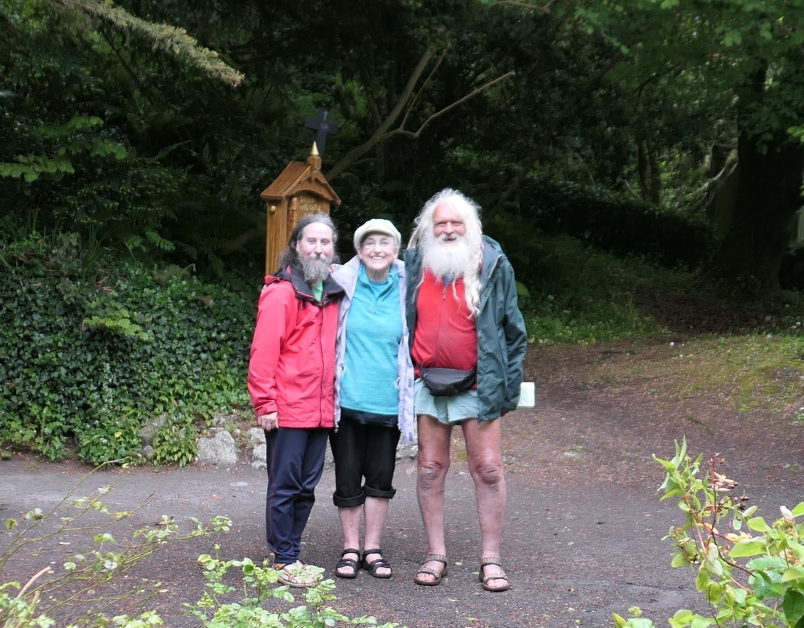
But I was wrong. Someone’s sacred site can be another one’s abomination. Here was a site celebrated by the Church since many a year, where crowds gather annually for the ‘Pattern Day’ festival of the saint. Actually, it’s probably only been considered sacred since the Penal Times, when church-going was banned and secret masses were held in secluded spots, often at the springs that became called holy wells. They were ‘holy’ because of their significance as a refuge for the performance of Christian rituals. Place stories pertaining to their ‘holiness’ or dazzling phenomena at them also abound, many reeking of concoction, with borrowed and Biblical themes. More fake news, perhaps, than real spiritual phenomena.
Many people think that Ireland’s holy well tradition is a continuation of pagan ‘worship’ at springs, when it was mostly just an historical necessity. There isn’t any evidence for pre-Christian use, Sam Moore, the archeologist from Sligo told us on a field trip to a famous holy well near Balinagleragh, in Co. Leitrim. (Springs often move, dry up or change course over time, which also might obscure evidence, if there was any.) Certainly there are never found pre-Christian stone structures around springs, such as the Romans might have created elsewhere. (Roman sacred springs were dedicated to spiritual beings that did enjoy ritual interactions with people and thus they would have similarities to the Irish holy wells.)
It’s a similar story with church sites in Ireland. There’s a (non-mainstream) notion that churches were built over previously pagan sacred sites. From my research into the Irish situation, this is not the case. They were mostly built on land donated by the elite, sometimes their own home sites, the ring forts with their circular walled enclosures. If the new church didn’t have the backing of the powers-that-be, they would never have got a foothold. St Patrick wasn’t as popular as we are led to believe and the early monastic institutions were part of the military-industrial-religious complex that dominated society and this continues today globally (just look at the way the Trump and Netanyahu regimes uses religion to justify warmongering and obscene genocide!). Read more about the early Christian times in Ireland in my book Legendary Leitrim, or Prof. Alice Robert’s book Domination.
Tobernalt holy well
So, the famous holy well at Tobernalt is a sacred site because it provides a pleasant outdoor opportunity to reinforce the Christian faith. The faithful bring with them their goodwill (but not gaiety, some signs there say ’Silence’) and enjoy the socialising and festivities, with people coming from far and wide on the last Sunday in July for the annual festival. This date links it to Lughnasa activities from pagan times, with elements of harvest festival continuation. But in pre-Christian times, things would have been very different to today.
I had not been to Tobernalt for some years and the site had had a recent major makeover, since some savage vandalism occurred there. Now this is a site that often hosts church services, it sports signage for serious ritual decorum, several of the usual concrete statues, and the like. The place felt and looked highly controlled. It was way too Christian for my visitor’s tastes and came across as a desecration to them. Laurence was most uncomfortable and so they stood in a circle for a little ritual of making amends and giving their blessing to the site.
A final assault on the senses came as we were hastily leaving, tracked by the shining new bank of surveillance cameras. We stopped to see a new statue set in a shrine amidst the trees. It was of a teenage saint boy from Rome, recently canonised as St Carlo, who was a big Catholic Influencer in his time. He was depicted with kind eyes, outstretched arms and a mobile phone in one hand. Was this a sign of the new ‘sacred’?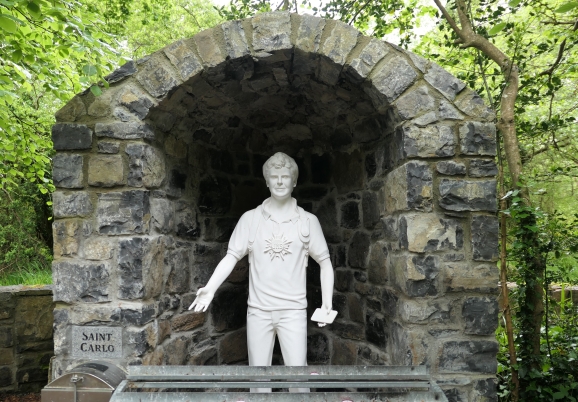
What is a sacred site?
The question begs – just what is it that constitutes a sacred site? A dictionary search suggests a place of revered human focus, that includes places ranging from temples to cricket grounds. It might be a good idea for geomancers to devise nuanced tools to analyse the typically high energy, spiritual sites for their sacred qualities. (Not forgetting the ethics and ownership of this knowledge, in terms of Australian Aboriginal sacred sites, that could also need consideration.) Tools that might assess present and past qualities, qualities that are under threat, or that could be enhanced, healed or harmonised for greater sanctity, etc.
Perhaps the reader may have their own ideas about this and would like to contribute to some discussion on the matter? Your thoughts would be gratefully received, with a view to future publishing in Geomantica. I look forwards to hearing from you!
Modern sacred site
On Saturday November 28th morning I will be leading a little field trip to a modern sacred site in Coogee (Sydney, Australia). I will describe the history of the site and some of the phenomena observed there, and we will dowse the powerful energies present. You are welcome to join in. Email for more information and the meeting point.
Enquiries – email Alanna – info@geomantica.com
WB Yeats and the fairy lore of Ireland
by Alanna Moore, September 2026
‘Faeries, come take me out of this dull world’…
W B Yeats, The Land of Heart’s Desire.
Acclaimed writings of William Butler Yeats (1865 – 1939), his poetry, plays, autobiographies and other works, are steeped in the Co. Sligo landscapes of Ireland’s north west coast, where he grew up. He drew heavily from the metaphysical landscape, in particular, through the indigenous folklore he encountered there. As a young lad, Willie, as they called him, would be transfixed by tales told to him by his mother, Susan Pollexfen (1841 – 1900) who also had a Sligo upbringing, and he soaked up the stories told by the household servants as well. Although from a privileged, non-Irish speaking Anglo-Irish Protestant family, neighbours bestowed on him the ancient land lore freely, in the homes he frequented locally. (Later, when he tried collecting folk tales from further afield, people treated the ‘outsider’ with suspicion and told him nothing.)
It sounded like an idyllic and blissful childhood for WB and his siblings. His brother Jack went on to become a high acclaimed artist, often depicting the beautiful Sligo landscapes of mountains and coastline in his works. Though the family moved to live in London and Dublin, they would have extended stays with family, particularly the Pollexfens at Merville. It was the best and only time of extended family connection and stability, and Sligo became a spiritual home for him. There they had the freedom to roam the countryside, often taking his beloved red pony out for adventures. Often his father John Yeats would read poetry to him as they sat near Rosses Point, looking out to sea.
His deep affection for the region shines through in his Autobiographies – “Certain woods at Sligo, the woods above Dooney Rock and those above the waterfall at Benbulben, though I shall never perhaps walk there again, are so deep in my affections that I dream about them at night.”
It was one night at Merville that young Willie saw his first fairy, through an open window and “moving down a moonbeam towards him” he wrote. It was through his Middleton relations that W B was made privy to the local folklore. “It was through the Middletons perhaps that I got my interest in country stories, and certainly the first faery stories that I heard were in the cottages about their houses. The Middletons took the nearest for friends and were always in and out of the cottages of pilots and tenants,” he said. This was in the area around Rosses Point and Ballysadare. The Pollexfens, who also had summer houses at Rosses Point, remained much more aloof from their neighbours, however.
Willie’s sister Lily explained that – “The servants played a big part in our lives. They were so friendly and wise and they knew intimately angels, saints, banshees and fairies.…All the talk among the servants was of fairies”. (A banshee is a type of traditional fairy woman that has a strong connection with certain families and announces their imminent death by visions and wailing.) When younger brother Bobby died in infancy, W B wrote: “Next day at breakfast I heard people telling how my mother and the servant had heard the banshee crying the night before he died.”
W B also heard sea-faring tales -“Indeed, so many stories did I hear from sailors along the wharf, or round the fo’castle fire of the little steamer that ran between Sligo and Rosses, or from boys out fishing, that the world seemed full of monsters and marvels.” While his heart stayed planted in Sligo, W B spent his life mostly elsewhere, although he was a frequent visitor up until his uncle George Pollexfen died in 1910. W B was especially fond of this uncle, who he often stayed with. Usually impoverished, he enjoyed his uncle’s hospitality and also shared interests. George was said to be a “celebrated occultist whose predictions were always fulfilled.” In his later years he focussed on astrology as well and was quite a mystic. He experimented with telepathy with his seer maid Mary Battle for many years. W B was also influenced by Mary’s visions. He wrote of how she saw, from a window at Rosses Point, “Queen Maeve and her warriors, ‘fine and dashing looking’, riding towards her from Maeve’s Cairn” on the summit of Knocknarea. (Maeve was an Iron Age queen, the cairn is neolithic, older by several millennia.) Mary’s vision inspired his poem The Hosting of the Sidhe, that begins: “The host is riding from Knocknarea”. (Sligo Folktales, Joe McGowan, The History Press, 2015, UK.)
While appointed to manage the family shipping business after the death of his father, uncle George’s management was “in name only, giving his time to the occult, horse rearing and Freemasonry – a not infrequent troika of interests to run in the mind of an Anglo-Irishman of the time”. A six month stay with uncle George in 1894 at Thornhill saw their friendship grow close, with their shared interests a great bond. The telepathy experiments they conducted also included his clairvoyant cousin Lucy Middleton. “Her chief power was an occasional pre-vision. I got with her my first proof of the old magical claim that names have a power apart from our obvious associations with them, at any rate from our obvious associations…. I found I had a reputation of a magician; there was a story among the country people of my being carried five miles in the winking of an eye, and of my sending my cousin from her house at the First Rosses to the rocks of the Third in a like eye-wink – I had indeed sent her there in a vision”.
Aunt Isabella Pollexfen sent W B a copy of A. Sinnott’s book Esoteric Buddhism in the mid 1880s and he was strongly affected by stories in it of the ‘little people’, of fairy raths and banshees. Inspired, he joined up with Charlie Johnson and they founded the Hermetic Society. In 1896 W B met Lady Augustine Gregory in Galway and together they went on to have adventures collecting folklore in that region together. He often stayed at her residence at Coole Park, where Lady Gregory had taught herself to speak Irish to be better equipped for her research. However it was Sligo that provided the greatest influence on W B’s life.
W B’s sisters Lily and Lollie also stayed with their uncle George. “Sligo was our paradise,” Lily wrote. When she stayed there on her annual holiday in September 1910, her letters to her father spoke of George’s last days. “Lily and his nurse heard the banshee 24 hours before his death on September 26th,” Lollie wrote. She described his funeral and burial as having featured “full Masonic rights and attended by the work force of the family firm.” Flags were half mast at the harbour.
W B’s fascination with the fairy world was not necessarily a healthy obsession. When he once asked a medium to contact the fairies for him a decisive answer was given, scribbled down on a piece of paper. “Be careful and do not seek to know too much about us,” it said. (Sligo Folk Tales, Joe McGowan, History Press, UK, 2015.)
in 1917 WB married Georgie Hyde Lees in London and they began to experiment with the practise of ‘automatic writing’. After receiving a bunch of disjointed sentences WB was thrilled. One encouraging ‘automatic’ message came that stated – “we have come to give you metaphors for poetry.”
W B died in France in January 1939. His wishes were for this to be a temporary resting place only. He wanted his remains to be transferred to Sligo in a year’s time and quietly interred beneath the mighty Benbulbin mountain, at Drumcliff. But war broke out and his wish wasn’t achieved until 1948. On the occasion, a military guard of honour waited to welcome his remains back to Sligo and an enormous crowd attended the re-internment.
Nowdays an annual celebration of W B’s legacy is held in Sligo town and his rich legacy lives on.
Reference –
Unless specified otherwise, the quotes in this article were extracted from-
‘Here you are somebody – the Sligo relatives of W B Yeats’ by Joyce Raftery Enright, in ‘Dedicated to Sligo – 34 essay’s on Sligo’s Past’, edited by Martin A. Timoney, Publishing Sligo’s Past, 2013, Ireland.
What’s happenning?
Geomantica Events in Malaysia and Australia. See the events pages HERE.
———————————————————————————————————————————————-